When people picture a private chef, they picture the cooking. The cooking is the smallest part. Booking a private chef means one professional plans a menu around your guests, sources the ingredients, cooks in your kitchen, serves each course and leaves the space spotless — usually around twelve hours of skilled work for a single evening. Because most of that work is the same whether you’re hosting two people or eight, the price is set per booking, not per plate, which is why the per-person cost falls as your group grows.
This is a look inside how it actually works: the hours behind an evening, how a menu comes together, how a chef plans quantities, how dining styles are chosen — and the honest reason two guests can cost more per head than eight.
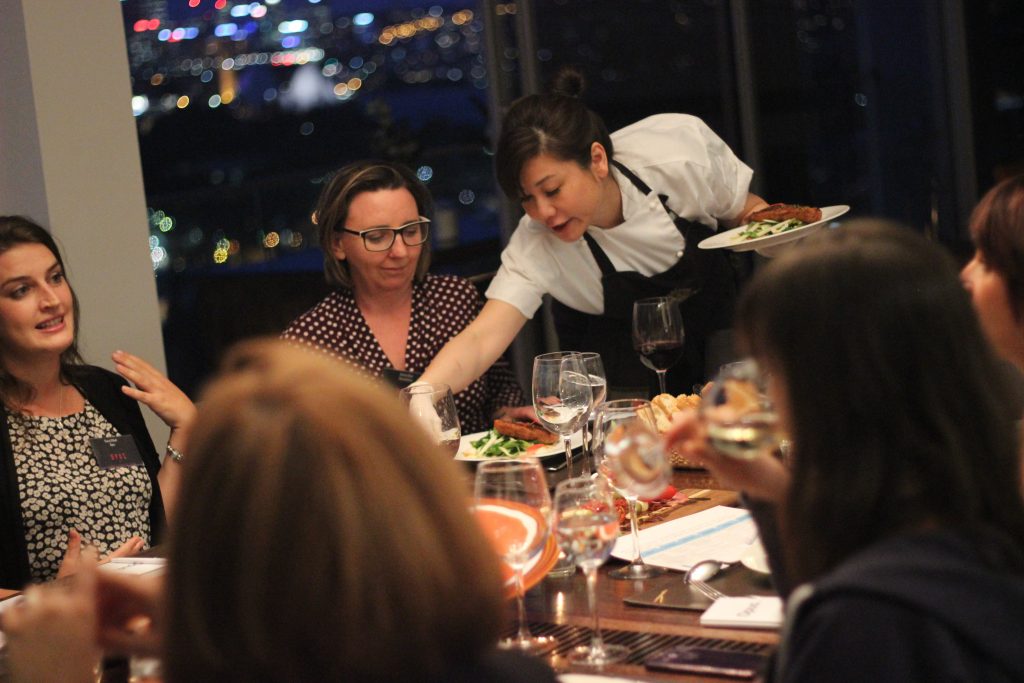
What a private chef actually does (start to finish)
A private chef runs the entire event, not just the stove. A single dinner typically moves through seven stages, most of which happen before the first guest arrives and after the cooking is done.
- Menu design & consultation. Understanding the occasion, your tastes, dietary needs and the kitchen they’ll be working in, then designing a menu around all of it.
- Sourcing & shopping. Hand-selecting produce, proteins and specialty items — often from several suppliers, not one supermarket run.
- Preparation. Stocks, sauces, marinades and components that need hours or a day ahead, done before arrival.
- Travel & setup. Arriving with equipment, ingredients and often waitstaff, then turning your kitchen into a working line.
- Cooking & service. Cooking each course to order and serving it at the right moment, at the right temperature.
- Plating & courses. Composing every plate so it looks as considered as it tastes.
- Clean-down. Leaving the kitchen exactly as they found it — dishes, surfaces, bins and all.
Do private chefs clean up? Yes. A professional private-chef service includes full clean-down. You finish the night with a tidy kitchen, not a sink full of pans.
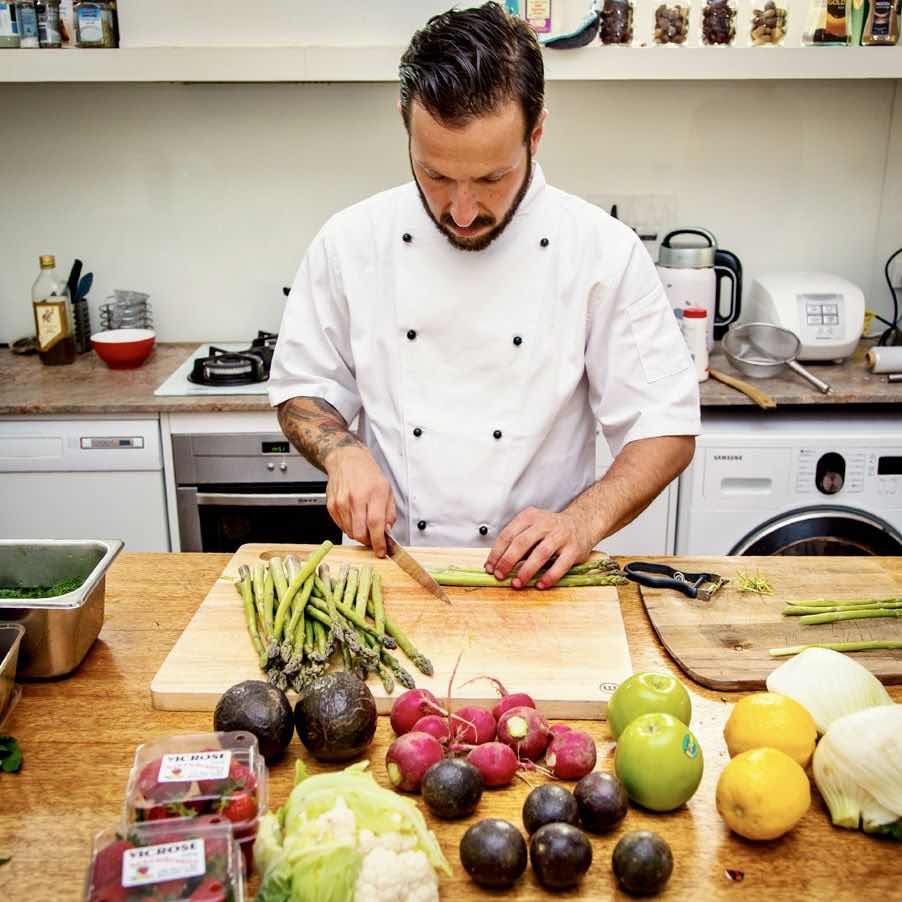
The hours behind a single evening
A three-hour dinner is rarely three hours of work. Once menu design, sourcing, prep, travel, service and clean-down are added together, a single event commonly represents around twelve hours of a professional’s time — and the more refined the menu, the more of those hours go into prep and plating.
Here’s how that time typically distributes for one plated dinner:
| Stage | Typical time |
|---|---|
| Menu design & consultation | ~1.5 hrs |
| Sourcing & shopping | ~2 hrs |
| Preparation | ~2.5 hrs |
| Travel (return) | ~1 hr |
| Cooking & service | ~3.5 hrs |
| Plating & courses out | ~1 hr |
| Clean-down & departure | ~1 hr |
| Total | ~12.5 hrs |
Illustrative for a plated multi-course dinner; exact hours vary by menu and venue.
The key point: almost none of those hours change when you add guests. Designing the menu, driving to the suppliers, setting up the kitchen and cleaning it down take the same time for two people as for eight. That single fact is what drives the pricing.
Why two guests can cost more per person than eight
This is the question that surprises people most: “why is it over $500 a head for two of us, but around $200 a head for a group of eight?” The answer is that a private chef prices per booking, not per plate — and most of the cost is fixed no matter how many are at the table.
Two things stay largely fixed for every event:
- The chef’s time. As above, roughly twelve hours of skilled work, plus the concierge coordination, waitstaff, equipment, insurance and the guarantee that sit behind every booking. None of it shrinks for a smaller party.
- A minimum ingredient shop. Chefs buy in whole units. A recipe might need a spoonful of miso, three sprigs of an herb or 100g of a specialty cheese — but they still buy the whole tub, the whole bunch and the whole wheel. For two guests, that unavoidable minimum shop is spread across two plates. For eight, it’s spread across eight.
So a smaller dinner isn’t more expensive because it’s less work — it’s more expensive per head precisely because it’s the same work, shared between fewer people. You’re not paying for more food when there are only two of you; you’re paying for one professional’s entire evening, undivided.
How a private-chef menu is designed
A private-chef menu is built around your table, not pulled off a fixed list. The chef starts with the occasion and the guests, then designs courses to suit — which is why two dinners at the same price can look nothing alike.
Dietary needs come first, not last
Allergies, intolerances, vegetarian or vegan guests, cultural and religious requirements, children at the table — these shape the menu from the outset. A good chef designs so that every guest is served something considered, not a lesser substitute plated as an afterthought.
Sample menus, not fixed ones
Most chefs share sample menus to show their range and style. Think of them as a starting point, not a set order — dishes are adjusted, swapped and personalised to your preferences and the season before anything is confirmed.
How a chef plans how much food to make
Portioning is a professional skill, and it’s the reason you don’t finish a chef-catered event either still hungry or buried in leftovers. A chef plans quantities around the number of guests, the number and size of courses, the time of day, the appetite the occasion implies, and how rich each dish is.
This is also where a professional quietly protects your budget. Over-ordering wastes your money; under-ordering embarrasses everyone. Judging that line — and buying to it — is part of what you’re hiring.
Choosing a dining style
The same menu feels completely different depending on how it’s served, so dining style is chosen to match the mood of your event.
- Plated & served. Each course composed in the kitchen and brought to the table — the most formal and the most polished.
- Family-style / shared. Dishes placed in the centre to pass around — relaxed, generous and conversational.
- Grazing & canapés. Standing, roaming food for events where mingling matters more than sitting.
- Interactive & chef’s table. The chef cooks in front of guests and talks through each course — the cooking becomes the entertainment.
The right choice depends on your space, your guest count and whether you want a seated occasion or a flowing one. This is worth discussing early, because it influences the menu and the run of the evening.
How to choose the right chef (it’s not just about cooking)
Two chefs can be equally skilled and still be wrong or right for your night. Beyond technical ability, the best match comes down to what a chef centres their food on — so it’s worth thinking about what matters most to you.
Tradition or innovation?
Some chefs honour a cuisine’s classics and execute them impeccably. Others live to reinvent, surprise and push a plate somewhere unexpected. Neither is better — but you’ll enjoy the night far more if the chef’s instinct matches yours.
Flavour-led or experience-led?
For some guests, the whole point is how the food tastes — everything serves flavour. For others, the theatre matters just as much: the plating, the story behind each course, the sense of occasion. Knowing which you care about helps match you to a chef who leads with it.
The fit around the food
Personality and presence count too, especially for interactive formats or milestone events where the chef is part of the evening. A private-chef service should match you on all of it — skill, style and temperament — not just hand you the nearest available cook.
Is hiring a private chef worth it?
For a special occasion, the real value isn’t only the food — it’s the experience a restaurant simply can’t give you. A head chef or sous chef cooking and plating an arm’s length away, talking you through each course as it lands. Handpicked seasonal and premium ingredients chosen for your table. Signature dishes you won’t find on any menu, built around your guests rather than selected from a fixed list. It’s fine dining turned into something personal, in your own home.
The convenience matters too, of course. No shopping, no cooking, no serving, no cleaning, and no leaving your own party to check the oven — you stay at the table with your guests from the first course to the last, while a professional handles everything around you. But convenience is the baseline. What people remember is the evening: the intimacy, the theatre of watching a talented chef work, and a meal made for them and no one else.
Frequently asked questions
How much does it usually cost to have a private chef?
Private-chef pricing is set per booking and shown per person, and it depends on the menu, the number of courses and the dining style. Because most of the cost is fixed per event, the per-person price falls as your group grows. CHEFIN’s packages start from $65 per person for cocktail canapés and from $195 per person for three-course fine dining, with all taxes included and nothing added at checkout.
Why does the per-person price drop for larger groups?
Because the biggest costs — the chef’s roughly twelve hours of work, plus service, equipment, insurance and a minimum ingredient shop — stay largely the same whether you host two guests or eight. Those fixed costs are shared across more plates in a larger group, so each guest pays less.
Do private chefs clean up after cooking?
Yes. A professional private-chef service includes full clean-down as standard — dishes, surfaces and kitchen returned to how they were found. Cleaning up is not an add-on you arrange separately.
How many hours does a private chef actually work for one dinner?
Around twelve hours is typical for a plated multi-course dinner once you count menu design, sourcing, preparation, travel, cooking, service and clean-down. The visible cooking is only a few of those hours.
Can a private chef cater to allergies and dietary requirements?
Yes, and dietary needs shape the menu from the start rather than being handled as substitutions at the end. Allergies, intolerances, vegetarian, vegan, and cultural or religious requirements are all planned for when the menu is designed.
Planning an evening?
If you’re weighing up a private chef for a dinner, celebration or special occasion, the easiest next step is to tell us what you have in mind. Our concierge team can talk through your guests, your menu and the right dining style, and match you with a chef who fits your night — not just your date.
Talk to the CHEFIN Concierge Service about your event.
Every CHEFIN booking is backed by vetted chefs, a replacement if your chef becomes unavailable, up to $20 million in liability coverage, secure payments and our Satisfaction or Money-Back Guarantee. Different chefs. Different cities. One standard of care.